
My good opinion once lost is lost forever.
In 2005 Elizabeth Bennet was reincarnated on the silver screen yet again. To some of us, this seemed wholly unnecessary since it had only been ten years since the BBC delivered Jennifer Ehle and Colin Firth to us on a delicious silver platter and, with apologies to Greer Garson, it seemed like we could sustain ourselves for a generation or two on that sumptuous and faithful rendition.
Universal Studios disagreed. They had just made major bank off of romantics crowding theatres for Bridget Jones’s Diary and Love Actually. I am partly to blame, having been caught in that sap myself. You have to understand that we were all apologists for some of this drivel at the time because it was such a welcome respite from what had been a very man-boy pop culture landscape. So when exceptions like The Notebook came along, we shrugged and slapped our money on the counter (because many of us still used cash back then) for a ticket.
Since that time, however, there has been a reckoning. Love Actually has felt it the most keenly, having been skewered in cinematic history as a thoroughly unromantic and insipid cash-grab.
Now it’s far past time that there was a reckoning for Lizzie as well.
If we’re being very honest–and in case you were not aware–the 2005 Pride and Prejudice film was a disgrace–an enchanting, very watchable, soothing disgrace, but a damn insult to the name Austen all the same.
If that makes you reach for your smelling salts, please hear me out. I am the first to acknowledge that the cinematography was perfection and the music was enchanting. That renders it a perfectly serviceable and enjoyable comfort flick, but it should never be considered the gold standard for Longbourn and Pemberly.
Come take the air with me and explore the eight key follies of the 2005 film.
Folly #1: JOE WRIGHT, Director
A young unknown television director named Joe Wright was brought onboard to make his feature film directing debut. The man had not read the book nor had he seen the BBC adaptation, which the studio justified as a refreshing perspective.
I would not necessarily be bothered by this, except that Joe took one look at the script and immediately envisioned it through the lens of his pet storytelling mode, social realism. And that, dear readers, is how he took what started as a Jane Austen adaptation and turned it into something very different and pertly inferior.
Job One: Change The Setting
Joe reportedly “hated” empire-waisted gowns (and apparently bonnets) and hinted that they were derivative, so he moved the story from 1813 to approximately 1795. That way, he justified, he could include commentary on the socio-economic impact of the French Revolution on the aristocracy.
Okay, boy.
Job Two: Dumb It Down
In a move that I find controversial and insulting, he wanted to alter the script to make it more palatable to mass audiences (especially in the US). Plus, he was quoted as saying of Austen’s text, “I don’t believe people spoke like that then; it’s not natural.”
Good gods.
FOLLY #2: Casting Elizabeth and Mr. Bennet
In spite of Joe’s warped vision, somehow the casting came out very well. Well, mostly. The mostly then-unknown Matthew McFadyen was a stroke of brilliance to bring a fresh manly take on Mr. Darcy. It was a substantial relief given that smooth-cheeked small pretty boys were quite the rage at the box office.
Elizabeth
In trade for this exquisite Fitzwilliam choice, they needed star power and they found it in Keira Knightley. The waif with the toothy smile was the darling of Hollywood back then and was hardly questioned as the choice to play Lizzie. Except I believe she was incredibly wrong for the part. I know, fan your lace collars now.
Even if we ignore the bodily proportions–which I am very happy to do–and if we try to ignore the subtle fish lips that would inflate and deflate from scene to scene as the collagen levels fluctuated, Knightley’s acting style is wrong for this role. She made a name for herself as a fierce warrior of an actress, embodying boldness, strength, and independence. Most of her piercing stares are provocative challenges to fight or seduce and her softer flirtatious style is to purse her lips into a thin “O” or launch a startling large smile.
None of this is bad at all, if it fits the role. However, Knightley not only had trouble shucking the ferocity of her tone, she also was unwilling to turn the volume down on these manners–or was instructed not to do so.
The result is that this Lizzie is played as a cool fish, a suppressed warrior, who seems unapproachable and joyless. Even bitter. Notice how she tries to withhold and remove herself from her family, including Jane. That distance she creates deemphasizes the tight family bond and isolates Lizzie in reveries of escapism and silent fits of frustration.
I don’t think I need to point out that Lizzie was supposed to be a bounding and cheerful character whose strength came from confidence, love, and family. She never sought to escape Longbourn and was relatively content with her life as it was.
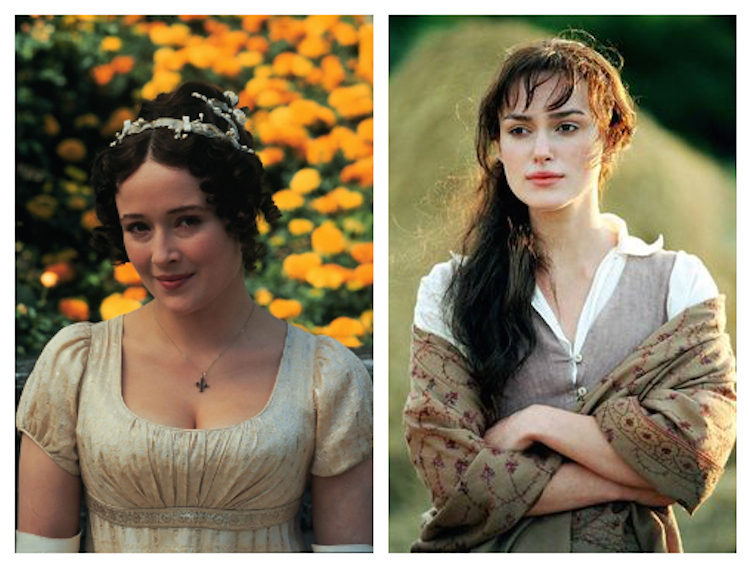
The photos of the two beautiful and talented actresses below (Ehle on the left and Knightley on the right) are brief illustrations of the different posture of our beloved heroine.
Mr. Bennet
Donald Sutherland likewise brought a twist on a familiar character by portraying Mr. Bennet as reclusive and perturbed by his family.
Sutherland was undoubtedly brought in for his rightfully celebrated star power. Plus Director Joe advocated for the casting believing that Sutherland’s gravitas was strong enough to “handle” the Bennet women. As if the Bennet women could ever or should ever be handled. Even if someone tried, it would not be this Mr. Bennet who was some muddled mix between angry and sleepy while trying to isolate himself from his family.

Really we all know Mr. Bennet was a lovable and malleable fool led around by the nose hairs by the ladies in his family. They may have exacerbated him, but in most of the family’s antics he was an active participant and not a victim.
Not to mention–and this is a crazy weird thing to bring up–in the final scene when Lizzie kisses his head in gratitude, it is painfully awkward to see that Knightley and Sutherland have enormously different head sizes. You could fit four Knightley skulls into Sutherland’s cranium!
Okay, I kid, but Mr. Bennet was exorcised of his charm, humour, and culpability.
Folly #3: Longbourn Manor
Just outside the doors of Longbourn Manor fluttered chickens and geese amongst the lines of laundry, all cluttering the muddy entrance. Director Joe’s vision that the family estate was a dowdy farm with livestock parading through the home. This is as misleading as it is ugly and ridiculous.
Mr. Bennet was landed gentry and his family lived a wealthy, comfortable existence on a prosperous estate luxuriously located in the countryside.
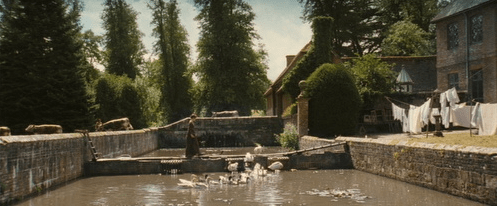
Allegedly, reducing the property’s grandeur was to emphasize the wealth disparity even within the gentry, presuming that audiences could not suss that out through dialogue and plot developments. Instead we were given visual aids, flip charts, mud pits, dirty stone floors, and drab colours that implied the matriarch’s desperation was based on elevating her daughters out of farm life. This, of course, lends undue credit to Lady Catherine’s fevered objections and Darcy’s early bias.
We know, of course, that there is no truth in that. Mrs. Bennet’s desperation was based on the lack of an heir and not the giant pig testicles flopping through the entryway. By the way, thank you, Director Joe, that was a charming zoom-in.
Since the Bennets were not grasping at wealth, only security, they should have had elegant and very fine decor blanketed in bright colours to emphasize their status.
Folly #4: Bennet Costumes and Hair
I have not the education nor patience to fully lecture on the missteps made in costuming this production. I know Director Joe hated the high under-boob empire waistlines. I don’t know why because they’re pretty great. But, okay. So most of the frocks are mid-torso waisted. That is at least somewhat keeping with 1790s fashion.
What isn’t accurate is how limp the damn dresses are. You should not be able to see through the fabric in sunlight, folks.
Plus, let’s talk about colour and frills. Sorry, Mr. Bennet, we need more lace! This was an era that heartily embraced bright colours and prints, not to mention feathers and lace and frilly bonnets. With a handful of exceptions, the colours are muted and sad through much of the film.
Remember that this is a wealthy family. They should be singing their status through brilliant fabrics and accessories. Especially Mrs. Bennet should be encouraging her girls to be little peacocks to secure their fortunes. Instead, Lizzie is wearing gowns that clearly look like they’ve been handed down and reworked to suit her. In no way should Elizabeth Bennet be dressed like a poor farmer’s daughter. And get her out of the grays and browns!
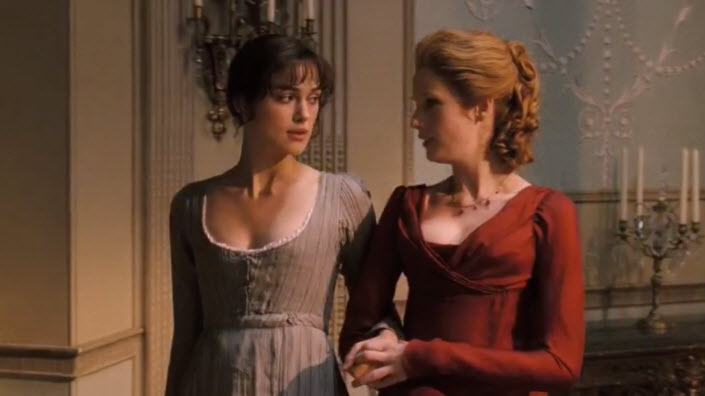
The hair though. Dear lords of literature, save us from the hair styles on the Bennet women. The hair was sloppy, tangled, and dripping all over the place. Let’s start with the bangs (aka fringe)–any would have been closely cropped and probably curled. Expose that forehead, ladies!
Then for the rest of the coif, please neaten it up. Tuck the tendrils and fly-aways. Pin what should be pinned. Do your servants not take any pride in styling you? Not only is it unrealistic, but it also promotes the idea that the family is slovenly and grasping without a clue for how to present themselves in society.

And for god’s sake, Elizabeth, when visiting in society, do NOT wear your hair down! This was a jaw-dropping misstep in society akin to wearing pajamas. Her flushed cheeks and hemline would have adequately conveyed her already controversial “wild” appearance. Hair up, hair up!
Folly #5: Bennet Manners
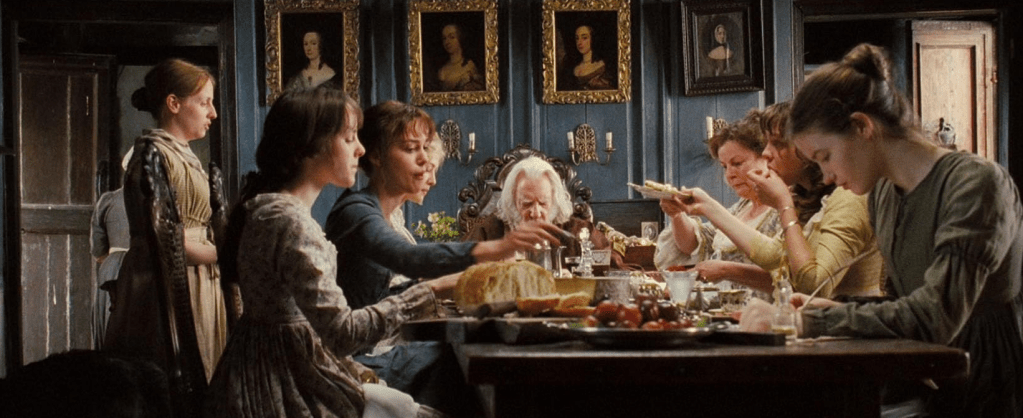
I won’t spend a lot of time on this one. Let’s just repeat a few rules, ladies, shall we?
Stand up straight.
Shoulders back, even when seated.
Do not slurp your food.
Do not lick your fingers.
Do not lean with your elbows on the dining table.
Do not lunge for serving plates and biscuits.
Your teacup does not require two hands.
When out walking, do not tromp like a caveperson.
When in a parlour, do not put your feet up on the couch, even if you desire to hug your knees (which you also shouldn’t do on the fine furniture–save it for the bedchamber).
Mrs. Bennet was raising ladies to be accepted in society, as was their rightful place. How on earth could she have accepted such boorish and inappropriate behaviour?
Folly #6: The Dialogue
I rather enjoyed Charlotte Lucas in this adaptation. Claudey Blakley does remarkable work with her role in spite of some horrendous tutorials she was forced to deliver on the rules of Regency society. “But why?”, she asked in exasperation after Lizzie tells her Mr. Collins is to inherit all of Longbourn. Charlotte knows why. Everyone knows why. The horse knows why. The pig’s testicles know why.
Similarly, when Lizzie is swinging and spinning in her mud hole for so many seasons and Charlotte finally arrives to steady the swing, she is forced to explain why being a late-20s spinster is a bad thing in the 1790s. We know Charlotte. The chickens know. The mud knows.
Outside of these insipid expositions, there is still a lot of hash that comes from a multitude of writers and rework on the script. Take the Netherfield parlour scene with the Darcy, the Bingleys, and Lizzie. Without context, it is actually a jumble of a conversation. Lizzie pronounces that she can’t possibly tease Mr. Darcy, and without justification or context for the comment. Then she declares that she dearly loves to laugh. She does? Elizabeth? Elizabeth Bennet? This Elizabeth Bennet? Well, between this and her slamming her book shut to hide her fondness for reading, it seems the writers wanted her to be flirtatious while blushing at any returns from Mr. Darcy. Naturally, this is nonsensical since Lizzie still very much despised Darcy and her entire stay at Netherfield.
Also, I must call out Elizabeth’s giddy declaration to Jane, “perhaps Mr. Collins has a cousin”. Yes. He does. IT’S YOU. YOU ARE HIS COUSIN. My husband is quite tired of me yelling that at the television and flinging things in disgust.
Folly #7: Mr. Wickham
Now we’ve come to it. Everything else is nitpicking, messy hair, mud, and pig testicles.
What on earth did they do to Mr. Wickham? If you don’t understand, let us begin that Wickham and Lizzie were meant to be friends, good friends. And with friendship came a blossoming attraction. In this film, though, the two barely interact. She blushes when he buys a ribbon and then sits under a tree and listens to his angry bullshit for an hour. After that, apparently she’s obsessed. We don’t know why. Handsome though he may be, he has no mischief or charm that would make him desirable.

Then something strange happens. Nothing.
All of a sudden he runs off with Lydia and we are just meant to accept that they fell in love or whatever. Keep in mind, dear readers, that his motives were (supposed to be) revenge, opportunity, and social climbing in the military. Moviegoers were deprived of young Mrs. Foster and her important Colonel husband. They would not see that Mrs. Foster and Lydia were particular friends. They did not see Wickham’s ambition to climb.
Further, moviegoers were barely made aware of the Georgianna history with Wickham and his need to humiliate and bleed Darcy. They didn’t see that Wickham was becoming subtly aware of Elizabeth’s attentions to Mr. Darcy and saw a convenient opportunity.
Instead, we are made to believe Wickham is just a bad man with no personality aside for latent anger at his new bride–which is also not explained.
Folly #8 The Sunrise Meeting
Here we are nearly to the end of the story and I confess to swooning at Darcy’s swagger as he emerges from the sunrise. I can almost forgive that both are basically dressed in pajamas and would be wholly shunned by acquaintances for such a scandalous meeting alone in such attire. (Even Marianne Dashwood wouldn’t have been this bold.) What I positively cannot not bear is the offense of Elizabeth’s love declaration being “your hands are cold.”
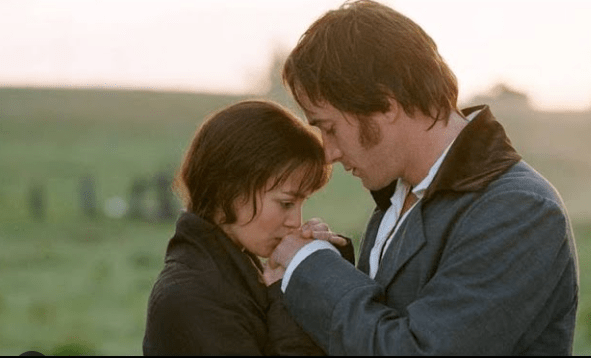
Nope.
Lizzie are Darcy are meant to banter about their own misunderstandings and the evolution of their feelings and characters through the impact of their knowing each other. It is meant to be a confession of love that is frank and heartfelt and trusting.
Not “your nose is wet”.
Even in my first-ever viewing I turned and look at other audience members as if to plead, “is this real?”. They cannot end it like this. That remains my sentiment as we stare into the cinematic future of this tale. They cannot end it like this. Not with Keira Knightley as the lasting impression of Elizabeth Bennet on an entire generation. Let us just hope that whomever comes next they endeavour to learn from past mistakes and be true to our loveliest Elizabeth.


 Katie Using Words
Leave a reply to Michael Kelley Cancel reply