
A card game for 3-8 players that is good for a quiet evening at home, or some time ’round the campfire.
Many years ago I went on a camping trip with a friend’s family to a remote cabin in the Canadian wilderness where you could see the stars at night and smell the fish during the day. I was only thirteen, but even way back in those ancient times, this was a vacation free of television, phones, and air conditioning. During those days when it poured rain and late at night when the crickets sung to the stars, we had little to do but play card games and my friend’s family had a clear favorite: Shanghai Rummy. It was competitive and exciting…and it helped pass long blocks of time without counting the cricket chirps.
Decades have passed and that friend and I had a very ugly falling out long ago, but I still remember loving that card game. Much more than I love her. So I pulled out a couple decks of cards not long ago to pass a quiet night, and realized I couldn’t remember a single damn rule. And worst of all, the interweb tubes cannot agree on the particulars.
In advance, I beg your forgiveness for not playing the way you and Granny or cousin BuberToober used to play. There are eighteen billion (no exaggeration) variations on how to deal, how to score, and even the round requirements. Are Jokers wild? Or should deuces be wild? Are there penalties for accidentally discarding a valid card? Make up your mind, Al Gore! Well, what follows is the most consensusy set of rules that also matches my memory.
Overview:
This is a card game that take a couple hours to play in which you collect cards in your hand until you have the right combo to dump them onto the table in front of you. The cards in your hand are your enemy and threaten to saddle you with points that keep adding up until your shameful, shameful defeat.
Needed:
- 2 decks of cards + 1 Joker (3-4 players)
- 3 decks of cards + 2 Jokers (5-8 players)
Basics:
- The game consists of 10 full rounds, for each of which the cards will be combined, shuffled, and dealt afresh according to set-up rules
- The goal is to earn as few points as you can by emptying your hand of cards. At the end of the round, points are determined by the values of the cards still in your hand (the cards on the table do not count for scoring purposes).
The Cards:
Much like various versions of gin or rummy, the goal is to collect “sets” or “runs” of cards and lay them down–a process that is referred to as “melding”.
- “SET” = 3 or more cards of the same value (ie 7s, Kings, etc.)
- “RUN” = 4 cards of the same suit (or more, as required), that are sequential in value (ie 9-10-J-Q of spades, or A-2-3-4 of diamonds)
- Aces may be high or low – but no Ace may serve as a high and low in the same meld (as in, K-A-2)
- Jokers are wild
Set-Up:
- 11 cards are dealt to each player at the start of the game
- The remainder of the cards are placed in a face-down stack in the center of the table as a “draw pile”, and the top card is flipped face-up beside it
- If a joker is pulled as the top card from the draw pile at the start of a round, bury it in the deck and pick the next card on top of the deck.
A Player’s Turn:
- Draw > [optional meld] > Discard
Rules For A Player’s Turn:
- DRAWING: When a player draws, she first has the option to take the top card of the discard pile.
- If the current player doesn’t want the discard, then other players (starting with the player on the left, and going clockwise) have a chance to sweep it up into their own hands. This is called “buying” it. The Buyer must also take the top blind card from the draw pile as punishment (remember, you want to have few or no cards in your hand at round’s end!). A player can only “buy” the discard up to 4x per round. It only applies to that first discard (nothing under it), and if no one wants it, it just sits there. Unwanted. Unloved.
- If the current player didn’t want the discard, then once its fate is resolved, she takes the top blind card on the draw pile as her draw for the turn.
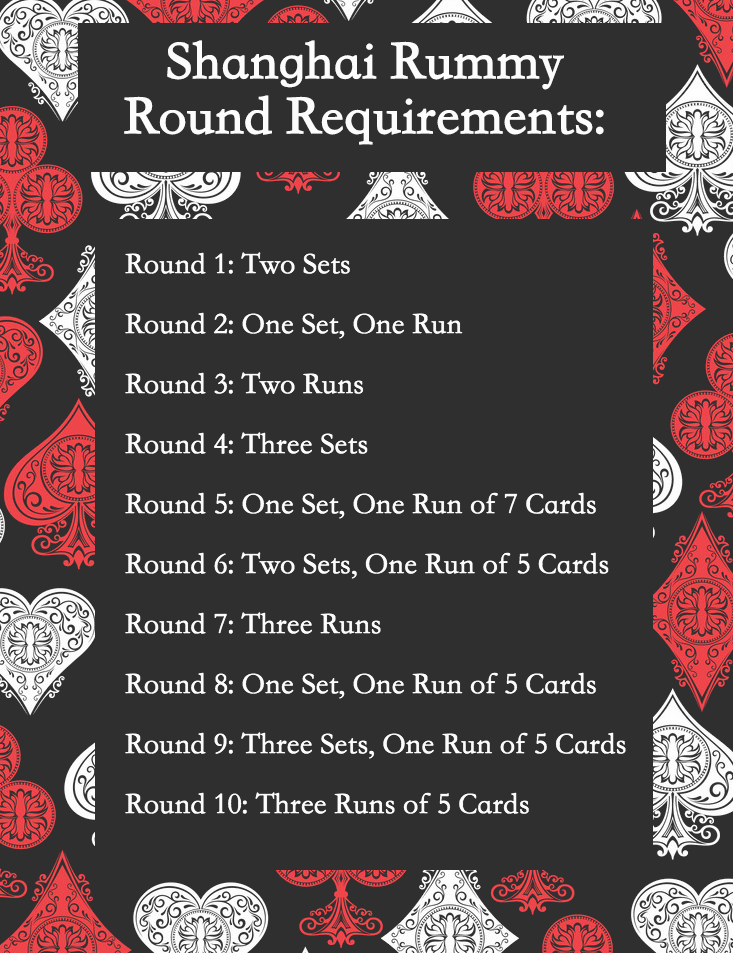
- MELDING: The player then has the opportunity to “meld” (lay down sets and runs of cards) if possible. The player can’t do this until she has met the round requirements (see below).
(Example: In Round 1, the player can’t lay down any cards until they have 2 sets to lay down). - No additional runs or sets beyond the round requirements may be laid down.
- After you’ve melded–and only after you’ve melded–you may begin laying down other cards to decrease the number of points in your hand, and work toward “going out” (emptying your hand and ending the round).
- LAYING DOWN OTHER CARDS: After you’ve melded, the only cards you may lay down add on to another player’s meld or your own.
Example: It’s Round 1 and you’ve melded three 5s and three Queens. Gladys over there (the one hogging the wine) has melded three Kings and three Jacks. You can take a King from your hand and lay it directly on Gladys’s set of Kings, thus getting it out of your hand and sparing you the points. It doesn’t actually impact Gladys. - DISCARDING: A player must be able to discard at the end of a turn (the final round is the only exception) and does so on top of the face-up discard pile–even if was a valid card that could’ve been played on a meld.
- Once any player discards their final card, the round ends immediately and scoring begins. Have a pen and paper ready.
Round Requirements
Scoring:
- Scores are then tabulated based on the cards still held in players’ hands only. This means that the player who went out receives 0 points that round. Remember, to win the game, you want as few points as possible!
- How to score the cards in your hand:
2-10 = face value
J, Q, K = 10 pts.
Aces = 15 pts.
Jokers = 25 pts.
- The player who went out may also have earned bonus points to subtract from her overall score:
If she “went out blind” (got rid of all her cards in one play) = – 25 pts.
If she went out blind with no Jokers = -50 pts.
- Keep a running count of scores through all 10 rounds, as the requirements keep shifting. When round ten is over, the player with the most points is a stinky loser. The person with the fewest points wins!
Sure, card game rules are hardly what I had in mind when I launched this website, but I want to offer you the benefit of my research. Plus, it’s also saved, so the next time the cats and I are drinking red wine, we can easily find our rules.


 Katie Using Words
Leave a reply to Bobby_Leo Cancel reply