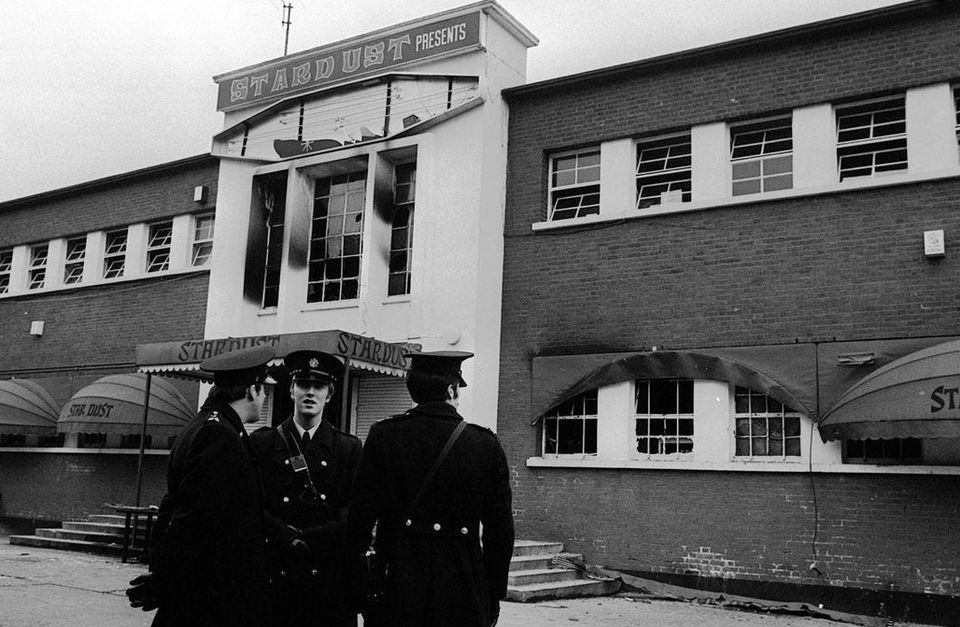
It was an age of disco and punk, wide lapels, and hairspray. 1981. Ireland. Friday, 13 of February, in a northern Dublin suburb called Artane, The Stardust nightclub held a Valentine’s Disco Championship Dinner. The girls and women glammed up and the young lads mostly donned jackets and ties. This was the place to be on that winter evening for a night of drinks, dancing, flirting, and fun. Over 800 young people showed up to boogie. Most were still there until the wee hours–after 1am on Valentine’s Day proper.
That’s when the fire started. Unbelievable heat, flames, choking smoke, burning droplets raining from the ceiling. Within a matter of minutes the DJ’s records had stopped spinning and flames engulfed the entire club, killing 48 people. Many of them burned alive, left unidentifiable in the ashen ruins. In some cases, dental records and jewellery were the only way loved ones could identify which body to bury. Hundreds who survived were left charred and maimed. Families were destroyed and suffer to this day and beyond. And no one has ever been held fully to account.
I want to tell the story of what happened.
It’s important, not just to honour and remember the lives that were lost, but to openly recognise the deception, reckless decisions, and intimidation that has shrouded a wealthy family at the centre of it, all of which has protected them from ever facing up to their own culpability.
To this day, more than 40 years later, investigations are still ongoing. I flip through news articles and websites trying to understand. Many overviews, like Wikipedia, are intentionally vague, given that the facts are so disputed and muddled. So I dig a little deeper. The story gets crazier, but it also becomes like quicksand, pulling me into forensic details and licencing and permits and fire service proximity. There is a void of information in between the two worlds of cautious summaries and ordinance mires.
I want to tell the story of what happened. I want to make it accessible and as honest as possible with the information available to the general public. I want us all to remember.
This is the story of the Stardust Fire.
CAUTION: What you are about to read contains descriptions of injuries, grief, harrowing situations, and people dying. No mortality photos are shown and I have opted not to share some of the most graphic descriptions of the fire victims here. Nevertheless, some readers may find some of the details troubling.
Before the Fire
The Stardust Nightclub was housed in the shell of an older factory. Built in 1948 by Scott’s Foods, Ltd. the plant made jams and jarred vegetables for many years. By 1978, though, the prominent and wealthy Butterly family had come into ownership of the factory and discovered it to be a money loser. In order to salvage their investment the then-owner patriarch, Patrick Butterly, began plotting a redesign. He wanted to repurpose the factory into a major entertainment venue. Originally, the concept was to set up a bowling alley, pub, restaurant, and warehouse inside the massive footprint. After planning and permission hurdles, the family eventually settled on three attached hospitality centres: A function room area called “The Lantern Rooms”, a bar called “The Silver Swan”, and a nightclub called “The Stardust”, with a capacity for 1,400 people. Patrick oversaw the construction and hired no architects or engineers in the process (aside from one team to strengthen the roof). Once the facility was ready to open in 1978, he put his son, Eamon Butterly, in charge of the venue management.
Here we can see what The Stardust interior looked like before the fire, starting with a view of the dancefloor and stage.

In this photo above, the photographer captured the view across the dancefloor toward the Main Exit. Tables and booths were arranged in a crescent shape around the dancefloor. Patrons bought drinks at three bars: A Main Bar (across the room), and two smaller bars, each just to the left and right of the stage. Above, you can see the Main Bar and one of the two smaller bars to the right of this stage. We will refer to as Bar #1.
A DJ and his staff had been playing on stage that evening. Precious minutes before the fire overtook the space, he had been playing the song “Lorraine” by Bad Manners and there were still kids dancing.

In this photo above, we get a hazy view of the stage from the vantage point of the Main Bar. What’s harder to see is that between the stage and the Main Exit is a secondary exit, through a door and down a small corridor–mainly used for chores such as loading/unloading audio equipment and was generally not used by the public.
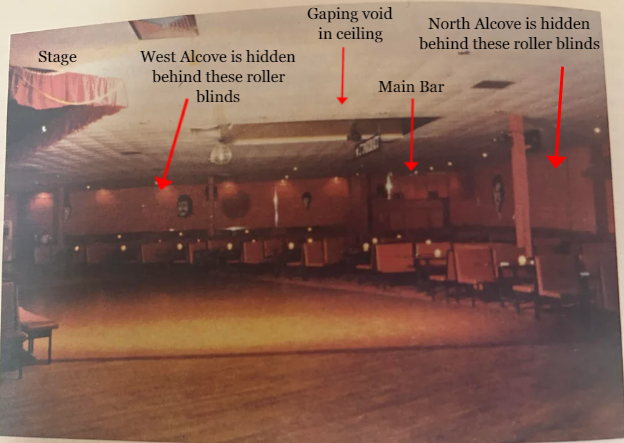
In this photo just above, the photographer here likely was standing in front of one of the two smaller bars that was just to the left of the stage. We will refer to this as Bar #2. To the person’s immediate left and right would have been two additional “emergency” exits.
Note the roller blinds above, strikingly decorated with floating faces. These blinds concealed two sections of tiered seating areas referred to as the “North Alcove” and “West Alcove” that were partitioned off for that evening’s disco. These blinds concealed the first tell-tale signs of smoke and fire in the West Alcove.

In this view from the dance floor we can see where the carpeting edged up to the wooden surface. This flooring delineation became critical to some of the patrons on the night of the fire.
JIMMY FITZPATRICK: 16 year-old Jimmy was at the disco that night with a group of fellow Superquinn supermarket employees. He was on the dance floor when the DJ made the fire announcement, and then saw a bouncer carrying a fire extinguisher to the West Alcove curtain area. He recalled that once the curtain was lifted the shock of air seemed to have fed the flames and they shot up to the ceiling. He made for the Main Exit (Exit 2), but then recognised two girls who were screaming near the cigarette machine but going nowhere. He went for them and threw them toward the doors, causing them to fall into the hallway. He tried to follow the girls but tripped on something like a handbag and fell down just as the lights went out. The crowd trampled him as he crawled along, before realising that he was on a wooden surface, meaning that he was heading toward the dance floor by mistake. He described that “you could chew the smoke, it was that thick”. He could also feel his back burning as he choked. He stood up and made his way to the sound of people battering a door, which then burst open. By the time he was outside he was covered in black, head to toe.
In addition to the two Alcoves, the Stardust had several other rooms not viewed here, including the kitchen (and its washup area), one set of public toilets, cloak room, cash office, cold room and storage (attached to the Main Bar, not visible to public), and backstage area (changing rooms, lighting controls, toilets, and more).
Above the west side of the building (kitchen, West Alcove and Main Bar) was a first story that had offices, a lamp room (electricals), and an unapproved storage space.
Before the Fire: The Disco Gets Underway
The Stardust Nightclub advertised a Disco Championship for Friday, 13 February. This was a big draw and boasted a prize of a £25 K-Tel record voucher to the winning dancers. In order to keep the bar open and party going late into the night, the Disco Night was dubbed a “dinner dance” with basic meals served to patrons. This allowed for a Special Exemption Order to serve alcohol between 11pm and 2am.
5:00pm – Full prep started about this time and, allegedly, a staff member first turned on the emergency lights.
Approximately 8:00pm – The kitchen staff had begun to heat the fat for frying sausages, both for the Valentine’s Disco and also a function in the Lantern Rooms.
Approximately 9:00pm – Staff turned on the heating system–though it was only partially operational according to staff members. At about the same time, DJ Danny Hughes and his five assistants arrived–including DJ Colm O’Briain and assistant Michael Barrett*–parking their van just outside of Exit 3.
9:40pm – The Main Exit doors were opened for admission and the disco night began. The admission fee was £3 per person. Men were supposed to wear ties and could not enter in a group unless accompanied by women.
SUPERQUINN STAFF: Approximately 15 of the attendees were Superquinn market employees, including Jimmy Fitzpatrick, Liam Dunne*, Mary Keegan*, Martina Keegan*, and David Morton*.
9:45pm – The staff dimmed the lights.
11-11:30pm – While the disco was underway, the adjacent Silver Swan bar closed for the night and the barmen cashed out. A few people hung around after close, including owner Eamon Butterly.
During the evening, the power to the DJ’s turntable and speakers was unexpectedly cut about 3-4 times due to (alleged) electrical faults, prompting apologies from the DJ. Otherwise the Disco seemed to be an uneventful success as the clock passed midnight into Valentine’s Day.
THE MCDERMOTT FAMILY: Siblings Willie*, George*, and Marcella McDermott* all attended the dance together. Marcella had told her parents she was babysitting. The three siblings would perish that night.
12:30am – The club stopped admitting people and doorman Frankie Downes locked the front doors and put the key in his pocket.
The Fire
NOTE: Reconstructing the exact timeline with dependable accuracy is nearly impossible due to a number of factors, including time, confusion, and the unreliability of unscrupulous actors. This timeline is based on the seemingly most reliable witnesses and evidence available.
The nightclub was filled with about 840 people, mostly between the ages of 18 and 30. By 1am, most of the crowd was still present, awaiting the results of the highly anticipated Disco Championships. Though it had been a long night of the crowd drinking and dancing, many of the attendees recalled feeling a bit of a chill through much of the night–presumably due to winter temperatures outside and the flagging heating system.
1:15am – Members of staff report smelling smoke but noticed nothing wrong. The Disco Championship got underway with competitors dancing the song, “Born to Be Alive” by Patrick Hernandez.
1:20am – Outside observers from nearby neighbourhoods claimed to see flames coming from the roof of the Stardust, small to start and then rapidly spreading.
NOEL SCULLY: The Artane resident lived close to the Stardust and on that night heard noises like fireworks. From his bedroom window he could see an orange glow in the skyline above the club. Within minutes–at approximately 1:20-1:25am–he got in his car and headed to the club where, after a 5-minute drive, he arrived and assisted the injured outside the club.
1:25am – One last patron attempted to trade in a ticket for his evening meal. The kitchen staff reluctantly agreed, even as they detected a smoky odour.
DAVID MULLIGAN: He was grabbing his coat to leave at 1:25am when he saw a bouncer walk a crying girl to the Main Exit. The bouncer opened the door with a key, let the girl leave, and then locked it again.
1:26-1:30am – (exact time disputed in contradictory reports) The DJ cut the music to announce the Disco Champions–Errol Buckley and Paula McDonald. The champs took the floor for a celebration dance, with the DJ inviting everyone else to join them for a reprise of the song “Born to Be Alive”. As many young people danced, 18 year-old David Flood* was sound asleep in his seat in the Main Bar area.
1:30am – Some of the patrons, including Linda Bishop, felt the temperature warming suddenly inside the club–but nothing to raise immediate alarm. She was relieved they had finally turned the heat on, though it was an odd choice since the night was winding down.
By this point, if smoke was intensifying enough to trigger an alarm, it would have only been heard in corporate offices. It was deliberately disabled within the club to prevent theoretical panic in the event of a fire.

1:30-1:38am – Somehow, the patrons of the adjoining Lantern Rooms were notified of the fire and started to exit.
1:38am – A taxi driver witnessed a few older people drifting casually out of The Lantern Rooms, drinks still in hand. The driver excitedly alerted them to a fire (visible to outside observers by this point), which they seemed to be aware of. Someone asserted the fire brigade was already enroute–unbeknownst to the people inside The Stardust.
Inside and outside the Club, witnesses reported hearing a bang sound. There was also a detection of a crackling noise according to an outside witness.
1:39am – The Lantern Room patrons were still calmly milling about the grassy outdoor areas with their drinks. The taxi driver was further advised that the fire brigade was on its way.
1:40am – More external witnesses rang 999 only to be informed that the fire brigade was aware and on its way.
Inside, the last dinner plates were being collected, even as one patron tried to cash in her dinner ticket (she was informed it was too late). Music was still playing.
From then things began moving very quickly.
1:41 – Peter O’Toole was occupied arguing with staff over his girlfriend’s purse, which he believed had been snatched. Dancing continued as part of the disco demonstration.
People seated near the West Alcove began to smell smoke. Some dismissed it as ashtray odour or something incidental, but a few curious people began to check out the roller blinds hiding the West Alcove area.
DEIRDRE RYAN: The 19 year-old saw smoke beginning to creep out of the partitioned area at about this time, while one of her friends looked under the screen and saw flames on some of the seats. Deirdre grabbed her coat and made for the door immediately, alerting people along the way that there was a fire.
Waitress Elizabeth Marley also witnessed flames on two seats behind the partition. As the seemingly small fire drew more attention at least one staff member ran to The Lantern Rooms to get a fire extinguisher.
MS. O’HANLON: She squatted to look under the partition and saw the flames also. As she began to collect her coat and purse, a friend shoved her clear of falling bits of ceiling.
Some clubgoers were still unaware of the fire. As smoke started to stream across the ceiling, many thought it was a special effect to close out the night. The DJ announced that there was a small fire, but urged calm. At about this time, doorman Frankie Downes unlocked the front door and a flurry of people exited.
Barman Larry Neville raced to the closed Silver Swan bar and alerted the few people inside, including owner Eamon Butterly, that the Stardust was on fire.
FLOOR MANAGER PHELIM KINAHAN: Owner Eamon Butterly saw the fire and (allegedly) said, “Those bastards have set us on fire.” Phelim then ushered people nearest the flaming seats to back away and he ran upstairs to the lights room to brighten the lighting inside the club somewhat.
1:41-1:42am – A patron who exited through The Lantern Rooms reported there was still no smoke in that area, though the smoke inside the Club was getting thicker, even as the music played on. The DJ had just begun to play the song “Lorraine” by Bad Manners.
Peter O’Toole was using one of the foyer payphones to ring gardai and report the theft of his girlfriend’s purse. His conversation with the operator was interrupted:
Gardaí: Hello, yes, hello.
O’Toole: I’m at the Stardust disco. Can you hear me?
Gardaí: Yes.
O’Toole: And my girlfriend’s handbag was robbed.
Gardaí: Your girlfriend’s handbag was robbed?
O’Toole: She’s the manageress in the shoe shop in Northside Shopping Centre.
Gardaí: Wait now would you….Stardust?
O’Toole: Yes, I’m in the Stardust disco, discothèque, and my girlfriend’s bag went missing, someone’s after taking it. Can you hear me?
Gardaí: Yes.
O’Toole: Can you hear me?
Gardaí: And where were you… where were… the guards, where will you meet the guards?
O’Toole: Pardon?
Gardaí: What’s your name… what is your name?
O’Toole: Hello?
Gardaí: What is your name?
[screams in background, caller hung up]”
As the West Alcove roller blinds were raised, the flames rushed to the ceiling inside the Club and the carpeted walls furiously ignited. Patrons began to run for the exits. 40 seconds into the new song, the DJ fled the stage.
Chaos ensued.
Allegedly, the owner, Eamon Butterly, attempted to approach the scene, but was repelled by the smoke.
White bits of the ceiling started falling, along with black charred pieces that were about the size of pennies. An unspecified number of staff worked to extinguish the flames for about 45 seconds, but abandoned the effort, observing at the time that the fire may have been above the ceiling. Burning jelly-like blobs started falling, setting more of the club–and some patrons–alight. Several patrons and members of staff recall red burning material dripping from the ceiling.
1:43am – Witnesses observed that while the heat from the flames was terrible, the heat from the ceiling was far greater. A witness then described that a massive “gush” of black smoke came out of the Main Bar area, and almost immediately after that, the lights went out plunging the Club into darkness. The emergency generators failed to come on.
By then, the fire had started to spread across the floor.
Witnesses outside of Exit 5 reported shouting at a young woman inside. She was confused and running in circles, her dress completely burned away. Onlookers coaxed her toward the door and she was nearly there when a ball of fire fell from the ceiling and set her ablaze.
1:44-1:45 am – The club was completely engulfed and the ceiling collapsed. In the span of that minute, rescue of people even a few feet inside the club had become virtually impossible due to the extreme heat and falling beams and fireballs.
FLASHOVER. At about 1:45am there was a flashover. This created a flash of superheated gases that would have scorched and otherwise damaged the respiratory systems of any person attempting to suck in air–assuming that the flashover of flames did not overtake the victims. The interior atmosphere became utterly fatal to any civilian in the main area of the club. Unsurvivable.
Music had still been playing about 3 minutes before this point. 44 people lost their lives inside the club, with another 4 passing away from their injuries shortly after the fact.
The fire’s final death toll was 48 young lives.
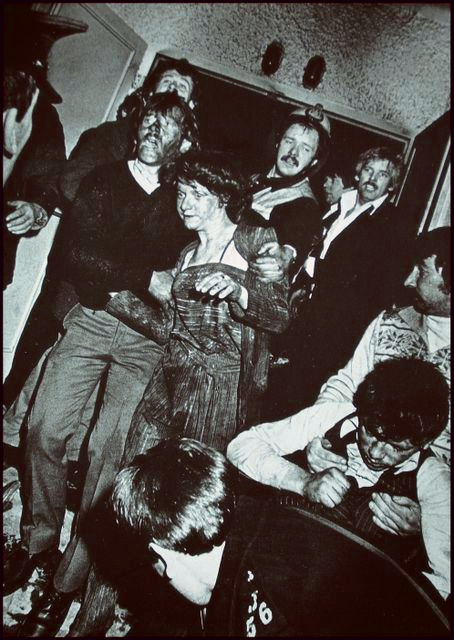
The Exits: Making an Escape
There are many alleged faults that led to the high mortality of the fire. We will explore some of those shortly, but the most high-profile and widely discussed issues have been the exits–some of which were chained and/or locked on the night of the fire.
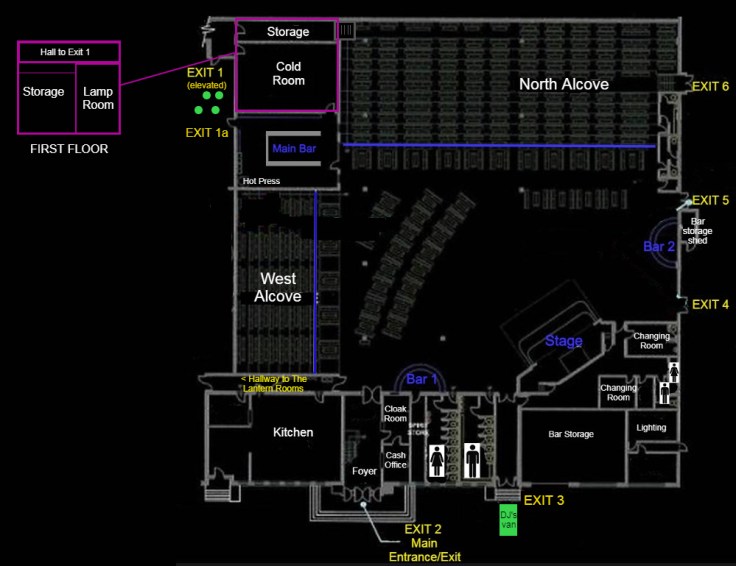
For reference, here is the floorplan of the Stardust.
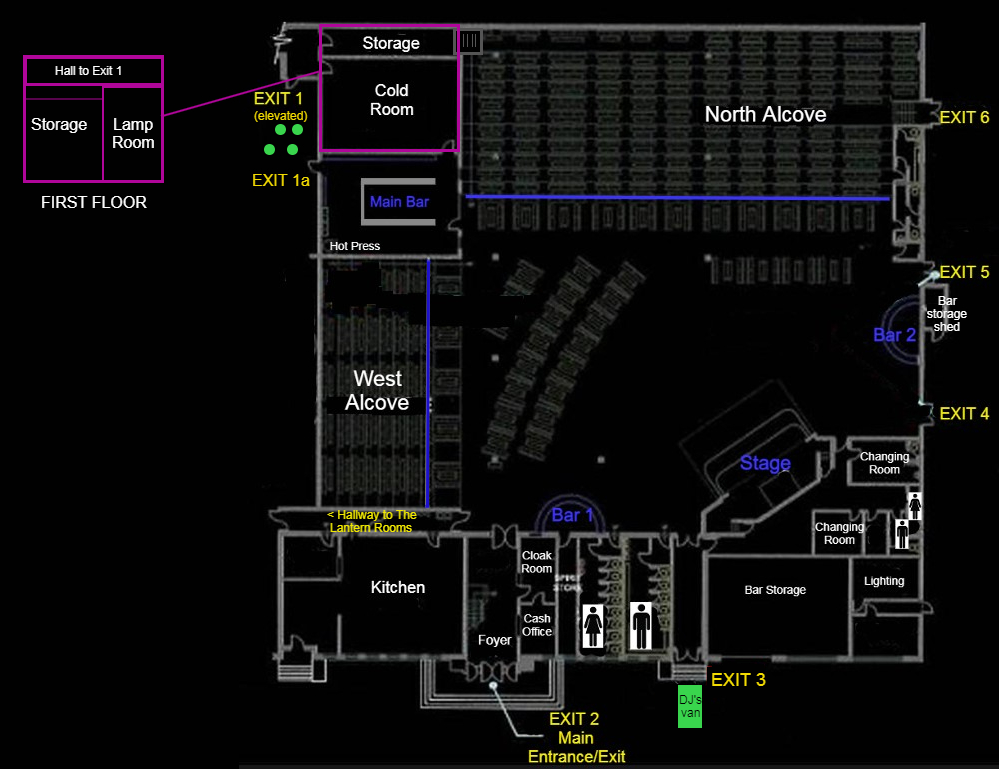
With the virtue of hindsight, time, and evidence, we can try to understand what obstacles may have hindered escape. It has never been totally clear, however, since some parties have spread massive contradictions and outright lies relating to the condition of various exits. Here is a breakdown of how the exits most likely (allegedly) functioned on that night:
EXIT 2 (Main Exit) – Exit 2, though locked earlier in the night, was successfully unlocked by doorman Frankie Downes while a number of people were already gathered to escape. Crowds pressed into the narrow foyer area and, at times, likely inadvertently forced the doors closed through shear force of shoving. Some were forced up the stairs, which had deadly consequences. Others were forced into the coat check area and in the dark smoky chaos, some of these people lost their bearings on where they were or how to escape.

CHRISTINE CARR: 16 year-old Christine headed to the lobby area in front of Exit 2 where there was already a mad crowd of people. The two doors were closed and patrons were banging to get out. She noted that it was like “breathing in tyres”. By that point she was so jammed, she could only swivel her head as she gasped for air. She recounted that she thought she was taking her last breath and “Mammy, Daddy, I’m going to die”. She still doesn’t remember escaping, but next remembered being in the car park on all fours, gulping for air.
EXIITS 4 and 5 – Both doors allegedly had thick chains wrapped around the panic bars, with padlocks hanging from them, creating the illusion that they were locked. (In theory, this was to prevent patrons or staff from believing they could admit non-paying people.) In the smoke, heat, and panic, it would have been extremely difficult to recognize that it wasn’t actually locked (again, allegedly).
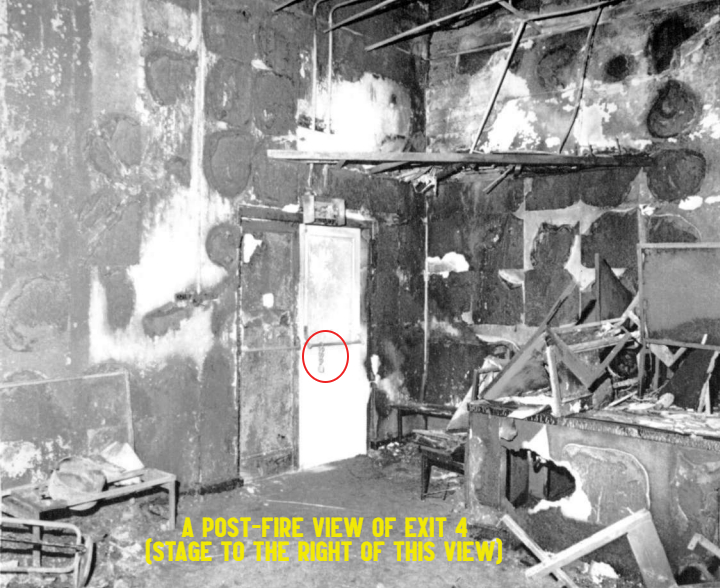
It appears likely that Exit 4’s chain was defeated quickly enough to allow many to escape. Exit 5’s chain, however, likely took longer to remove, as noted by more significant burn damage to the inside of the door (compounded with Fergus Kane’s account). According to at least one witness there were crates blocking Exit 5 and between six and seven people were trying to move them.
Some reports suggest that there were a number of bodies discovered in close proximity to Exit 5–but keep in mind that body locations have been in major dispute. Because of the discrepancies, lack of thorough investigation, and the nature of the physical damage to the deceased, I am reluctant to speculate or describe body locations here.
MARIE HOGAN: She and her husband, Eugene “Hughie” Hogan*, who was 24 at the time, (both the parents of two children), were celebrating a departure to Kerry that was due the next day so Hughie could take a cabinet maker job with Marie’s father. When the fire panic began, Hughie told her he was going to get the coats and she should wait, that he wouldn’t be long. Then the lights went out. The crowd pushed her to Exit 4, but when a chain frustrated the crowd, she was pushed to Exit 5. After repeated banging, the door eventually gave way. As she waited outside, people reassured her that Hughie had gotten out. But she never found him and once the roof collapsed in the area where they had been sitting, she knew he was gone.

FERGUS KANE: Fergus was at the disco also to celebrate a farewell to the Hogans. As the smoke engulfed 18 year-old Fergus, he pulled his coat over his head and made his way to Exit 5, which he found chained. He attacked the door with his shoulder, but to no success. He then made the (arguably unwise) choice to shelter under a table until he saw a firefighter’s torch light through the exit.
[The rescuer may have been Floor Manager Phelim Kinahan, who recalled using a torch to spot people crouched not far from the doors and pulling two of them out.]
JIMMY TARPEY: Jimmy had noticed the chains and padlocks on the doors on previous nights and had even confronted a doorman about them, being told to “fuck off”. When the fire broke out, he and a friend headed to Exit 5, but recalling the chains and locks thought to himself, “I’m going to die tonight.” Somehow, just as he and his friend reached the door it burst open.
EXIT 3 – There is contradictory information about whether or not this exit was chained and padlocked or if the chain was merely wrapped around the bars, as was the case with several other exits. According to staff, the former likely would have been the case. Former staff member Noel Quigley, noted that he did attempt to admit some friends for free that night via Exit 3, but found it chained and locked.
MARK SWAINE: He and his girlfriend headed for escape via Exit 3. The passageway in front of the doors was already full of a number of people and he recalled a lot of screaming. He heard someone shout, “get the chain off the door for fuck’s sake!” The people in front of him were kicking the door when it suddenly burst open. Upon exiting he saw people outside who were still burning and smouldering. He made attempts to break windows and aid the people still inside.
CHRISTINE FULLAM: 31 year-old Christine realised something terrible was going on when she saw black smoke swirling across the ceiling. When she saw the Main Exit (Exit 2) was jammed, she moved down the hallway to Exit 3, only to find the doors shut and seemingly locked. She recalled that the chains were wrapped tightly around the bars and she held the padlock in her hand and pulled at it several times to no effect. Three tall men then came running and were running and jumping and kicking at the door. After the third time charging the door it burst open.
A minor additional complication was that the DJ’s van was parked as seen below on the night of the fire.

EXIT 6 – Former staff member Noel Quigley has stated that this door, too, was chained and locked that night as he attempted to admit friends for free. However, expert testimony has suggested that the lack of damage to the interior of this door points to the door being opened early during the emergency.
EXIT 1 – This was very likely fully locked, as was habit every night. The staff was instructed to pile rubbish bags in the corridor during clean-up, then lock the doors behind them. Patrons were eventually able to break through these doors and emerge on a small fire escape landing.
LIAM “LEO” HENNESSY: 31 year-old Leo was in the Main Bar area with his friend, 18 year-old David Flood*, who was asleep in a bar seat near him. Once Leo saw the smoke coming from the curtained-off area and heard shouts of fire, he attempted to shake David and grab him by the legs, at which point the bar was ablaze. Unaware if David was waking or not, Leo started grabbing at the 18 year-old’s shoulders when a fire ball swept through. Shortly after that everything went dark and he thought he saw another friend handling David. That was when Leo headed Exit 1. He described that in his state of shock and in the warmth of the blaze, he wanted to sit down and go to sleep. He reached Exit 1 and was pushed through the exit, which he thought was on fire. He made it down the steps away from the exit barely able to breathe and had to stick his finger down his throat to get rid of the “smoke”. After that he heard some bangs from inside the club and saw a huge flame shoot into the sky. He had hoped to still see David emerging from the Club, but sadly that never happened.


PATRICK MAXWELL: Patrick, like many others, thought that the smoke was a special effect at first. When overwhelming heat prevented him from moving to the Main Exit, he spied a barman at the [Main] Bar. Patrick jumped across the bar where the barman pointed out exit 1A behind the bar (which no one else appeared to be using). Once he got outside, Exit 1 (on a small fire escape landing just above him) burst open with people exiting. Some of their clothes were melted on to them.
THE TOILETS – Some people attempting to find Exit 2 ended up in the Cloak Room or toilets by mistake. Some toilets had metal bars on both the inside and outside of the windows. The steel outer bars were so strong, firefighters using chains to pull the bars away were unsuccessful. Other toilets had metal sheets covering them, as seen below. They had recently been outfitted to prevent teens from handing off drugs and booze through the windows, allegedly. In reality, the windows were probably most commonly used to hand off neckties to men outside so they could meet the dress code and be admitted.
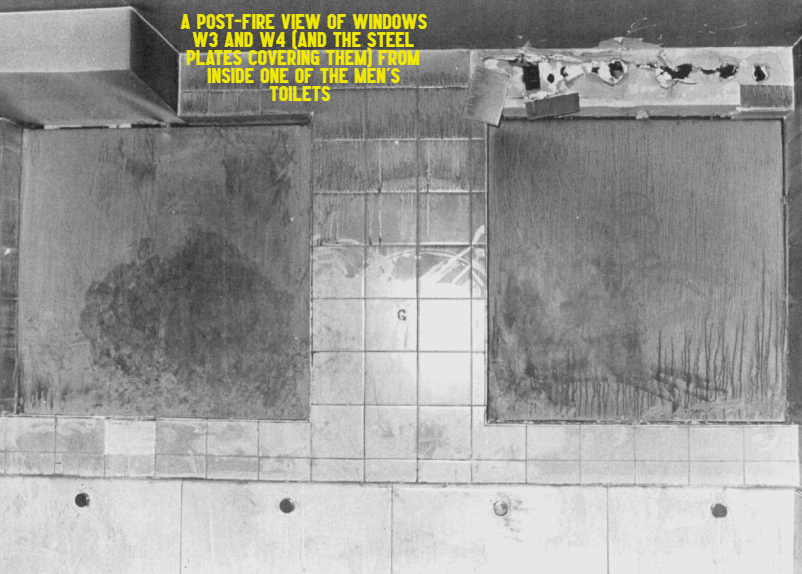
PETER O’SHAUGHNESSY and DEIRDRE DAMES: 17 year-old Peter recalled that in the panic of the fire he saw a girl fall to the ground and people trampling her. He tried to help her, but was also knocked down–and then the lights went out. He got up and saw a burst of flames in front of him and in that light he spotted the toilet doors. He shoved the girl inside the toilets, following her in alongside another girl–almost certainly 18 year-old Deirdre. They splashed water on their faces and Peter tried to punch out the window, only to find it was a sheet of steel. The trio huddled in the corner and breathed through their clothes while people outside shouted that rescue was on its way. Overwhelming heat and smoke filled the bathrooms and–not being able to breathe or swallow–Deirdre stuck her head in a toilet bowl for more water. Whenever she lifted her head, all she heard was screams. Peter continued to bang on the steel sheet and after an untold number of minutes a fireman appeared and rescued them.
LOUISE MURRAY: She had been boogying on the stage when she first witnessed the blaze. She was still there when the lights went out and moved with others to a one-room toilet behind the stage. When thick black smoke started to fill the space she turned right and ended up in the star’s dressing room. She used that room’s toilet cistern to get relief from the scorching heat. She took pints of beer and kept swishing them in her mouth until she and others were rescued by firefighters.
Fireman NOEL HOSBACK: He heard appeals from people onsite that their friends were still inside. He made his way through a window into the main Stardust ballroom. Making his way to a ladies’ toilet he found three people awaiting rescue. He lent them his breathing apparatus and then–with the aid of other firefighters–helped them escape.
The Cause
How did it happen? Knowing the cause of the fire might be a small measure of cold comfort to survivors and family. However, the cause has not only never been settled, it remains a thorny point of contention. There have been three primary theories.
Arson Theory (debunked)
This theory cannot even be broached without first stating that there is ZERO evidence to suggest that the fire was started intentionally and it continues to be insulting to the survivors, family, and memories of the deceased that this was ever accepted as truth.
A Judicial Tribunal was convened in 1981 under the auspice of Justice Ronan Keane, holding its first public meeting 12 days after the tragedy. The Tribunal based their findings on the timeline of witnesses sighting flames inside the club (ignoring eyewitness accounts from outside the building), with the presumption that someone set the seats on fire, either accidentally or intentionally with matches or a cigarette.
In what would be a spectacular coincidence, this jives with what owner Eamon Butterly allegedly said at first sighting of the fire: “Those bastards have set us on fire.” RTE also reported in the days following that there were a “number of allegations” that witnesses saw someone trying to set fire to a seat, though none of this reporting could be verified. Arguably, this immediately influenced the focus of investigators and deflected from other evidence.
The resulting (faulty and disputed) arson finding of the Tribunal effectively exonerated the Butterly family at the time and paved the way for the Stardust owners to receive over £700,000 in compensation from the state.
A later assessment by fire consultant Tony Gillick refuted the arson conclusion, noting that the evidence given by Linda Bishop and others would have to be summarily dismissed in order to believe it. Additionally the alleged arsonist would have required more skill at accelerating the flames than the Tribunal’s expert testers.
Professor Michael Delichatsios, a University of Ulster chair in Fire Dynamics, gave his expert opinion that the fire was initiated in the first floor store room and that the seats ignited due to falling burning items.
Fire Inspector, Dr. Will Hutchinson confirmed that gardai found no accelerants and there was no evidence of arson. He further asserted that it would’ve been very unlikely someone could have lit the seat covers and would have needed a jacket or a cut in the seating to ignite the foam inside. While some of the seat covers may have been cut in the Lantern Rooms, there is nothing to suggest this was the case in The Stardust.
The arson assertion defies logic and evidence and should be totally dismissed. It is generally considered debunked from both a legal and social standpoint.
Electrical Issues
It appears from eyewitness accounts that the entire Stardust complex (including The Silver Swan and Lantern Rooms) may have had ongoing electrical issues.
DECLAN BURNETT: Declan was a glass washer who worked in the Main Bar of the Stardust around the time of the fire. He reported smelling burning rubber at times during the course of his work.
In July, 1980, ESB (Electricity Supply Board) was called out for a power failure. There was an arcing in the main breaker, at which point the Club was advised to reduce the electrical load and replace the breaker.
STEPHEN BYRNE: An electrician based out of nearby Coolock was a patron at the Silver Swan on the night the fire. He noticed a roof-level neon strip that was dimming and flickering and seemed to have a short in it, based on years of working specifically with high-voltage neon signage. He later testified that this was a fire hazard.
A Senior Counsellor representing the families has asserted that expert electrical reports detailed defects in the Stardust’s electrical installation, including overloaded circuits near the stage. Apparently a bank of additional sockets (outlets) had been added and multiple lighting units were powered through that socket system–something that if true, would have been hazardous.
PETER REDMOND: Peter was a patron at the Stardust on the night of the fire. He was at the [Main] Bar when he and other witnesses spotted the glow of flames. He eventually escaped out of Exit 2. Only the week before, he had been at the Stardust when most of the stage lights, ceiling lights, and power to the microphone flicked off. An unknown man came out and worked at the plugs until the issue was fixed.

Most experts and witnesses acknowledge that it is possible, or even likely, that the fire was of an electrical origin. The question remains where–and to what extent was it preventable.
First Floor Storage
There has been a long-held and controversial theory that an electrical fault may have ignited in the first floor Lamp Room, which was adjacent to a Storage room allegedly filled with highly combustible materials.
The first floor area in question had not been included in the original planning and permissions phase and was errantly labelled as ground-floor space (over a non-existent basement) on the primary Garda Map. This failure of oversight and alleged negligence allowed the first-floor rooms to be constructed outside of Building Construction Good Practices. Both the Lamp Room and Store Room were partially enclosed by timber partitions, which were not in compliance with fire-resistance requirements. They should have been surrounded by solid fire resistant materials from the concrete floor up to the asbestos roof covering.
Further problematic were the contents of the storage room. And it seems likely that the Butterly family was aware of the potential problems. There have been unconfirmed suggestions that staff members were (allegedly) coached on the testimony provided to Justice Keane in the 1981 Tribunal. This could explain why the list of store room contents changed dramatically over time.
The most recent and reliable evidence suggests the store room was filled with the following:
- 40-50 (5-gal. drums) Cooking Oil
- 20-30 (5-gal. drums) Cleaning Fluid
- (unknown number of drums) Liquid Floor Polish
- (unknown number of drums) Detergents
- Dozens of boxes of Plastic Glasses
- Dozens of boxes of Napkins
- Boxes containing Brio Wax and Toilet Cleaners
- Dozens of large boxes of Toilet Rolls
- Dozens of boxes of Plastic Utensils
- Dozens of boxes of Kitchen Rolls
- Dozens of boxes of Paper Plates
- A large Chest-Style Freezer
- Boxes of Condiment Sachets
Note that early testimony provided by staff curiously omitted the cooking oil and cleaning fluid drums–both of which were incredibly combustible and (allegedly) stored in enormous quantities in an unsafe space.
If the Lamp Room had an electrical fault that sparked a blaze, this could explain the flames that were visible in the roof area, the ability for the fire to spread through ceiling space without being immediately spotted internally, and the devastating temperatures. In such a scenario, the fire would have been well underway as early as 1:15am when staff first noticed a smoke odour–before the disco champs had even been announced. It could have spread through the ceiling space and roof until flaming bits fell down to idle seats in the West Alcove.
Gardai Forensic officers never sifted these areas.
The chief argument against this theory is that there were so many electrical lighting circuits in the ceiling void that any significant fire spread would have taken out the lights much earlier on–perhaps.
The Hot Press
2024 expert testimony has proposed an alternative theory–that the fire’s origin was on the ground floor in a Hot Press area of the Main Bar, which is where two immersion heaters were housed. Fire Inspector Dr. Will Hutchinson has testified that there was localised fire damage around the hot press that did not exist in other parts of the Main Bar. Additionally, there was possibly a resistive heating fault inside one of the immersion terminal covers–in other words, faulty electrical connections with one or both of the immersions.
This theory suggests that the faulty electrical connections ignited the room and may have spread upward through a hole in the ceiling, while also migrating to the adjacent West Alcove.
Arguments against this theory include eyewitness reports of flames visible from the exterior several minutes before patrons were aware of a fire inside. Those reports aren’t preclusive to the Hot Press theory, since the fire could have travelled upward in a chimney-like fashion for an unknown duration before patrons or staff discovered it. The outside accounts don’t necessarily buttress the idea either since the flames were so visible from a distance, yet inside no one reported additional heat coming from one side of the bar, nor did anyone report hearing any crackling or seeing any smoke from the hot press closet area.
Responsibility
The exact cause of the fire will almost certainly never be determined. What we can easily surmise based on evidence is that there was a devastating level of negligence and endangerment on the part of the Butterly family. The Hot Press or Lamp Room. In the end, neither really matters. Neither was known to be in keeping with safety standards and the former was known to be faulty. Both were hazards, either could have contributed and/or caused the tragedy. When considering either, keep in mind that additionally under the leadership of Eamon Butterly:
- Exits were chained and/or locked in order to prevent “troublemakers” from getting in his club without paying the cover charge.
- Windows were covered in bars and metal sheets, presumably to prevent petty crimes.
- Portions of the Club were constructed using improper materials and lacked proper permits and inspections.
- Fire alarms were disabled within the Club.
- Emergency lights, which would have greatly aided in escape and rescue (and which were required by law) never came on.
- Staff were never trained in fire drills, nor given training for such emergency scenarios. On the night of the fire, there was no one in charge, no one to give directions or coordinate aid. And that includes Eamon Butterly–who was present.
- The walls of the club were lined in highly flammable carpet tiles that accelerated the fire.
- Underage teens were regularly admitted without ID and permitted to drink alcohol.
- Staff were (“allegedly”) coached to present a favourable representation of Butterly family management immediately after the tragedy.
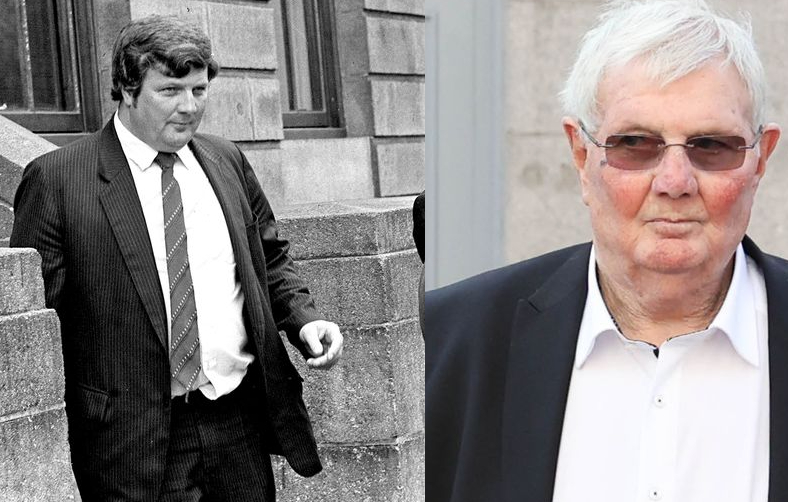
Eamon Butterly, owner of the Stardust Nightclub in 1981 and in 2023. Survived the fire.
The owner was awarded damages under the assumption that one of the clubgoers lit his club on fire (which is now completely debunked). AWARDED damages.
If any reader is pondering remorse or guilt on the part of the Butterly family, consider the following: In 2006–on the 25th anniversary of the Stardust inferno–Eamon Butterly attempted to open a new bar, callously named “The Silver Swan”, on the site of the Stardust Club. It was replacing a differently named bar. He selected the name to capitalize on the 25th anniversary. Only after victims’ families protested did the bar’s name change to Artane House. Money.
Remembering the 48 Lives Lost
Nothing can bring them back. But they are not forgotten. Innocent and treasured lives lost too soon.
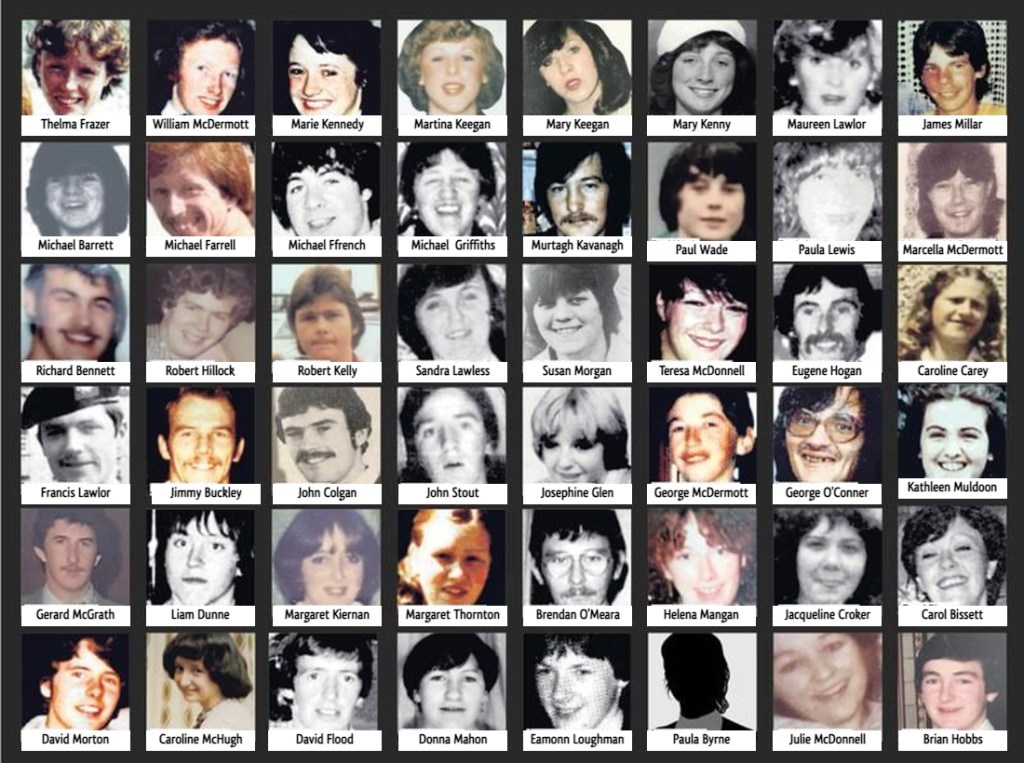

APRIL, 2024 UPDATE: A 100-day long inquest into the fire returned a verdict of “Unlawful Killing”, finally and legally acknowledging a truth long-known. The consequences for the Butterly family are still unknown.
To this day, some of the unmarked burials are given a name through DNA testing. They are still remembered and missed.
SOURCES:
https://stardustwalloflies.com/
https://magill.ie/archive/truth-about-stardust-fire
https://www.stardustfireinquests.ie/
 Katie Using Words
Leave a comment